

www.lifelinebatteries.com 1-800-527-3224
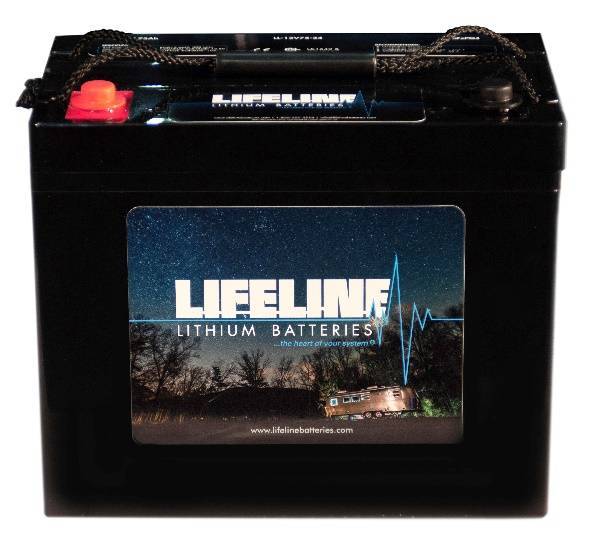
LL-12V100-24
The Lifeline Lithum LL-12V100-24 LiFePO4
Deep Cycle battery is a drop-in replacement
for a lead acid battery group 24. The highest
capacity in the smallest package yet! 100
available Amp Hours in a Group 24 size!

LL-12V100-27
The Lifeline Lithum LL-12V100-27 LiFePO4
Deep Cycle battery is a drop-in replacement
for a lead acid battery group 27. It can
charge up to 5 times faster than lead acid
batteries. It also includes an internal heating
system that allow charging as low as -4°F
Bluetooth Monitoring 
LifePO4 with Bluetooth Connectivity!
Easily monitor the status of your battery
bank from your mobile device
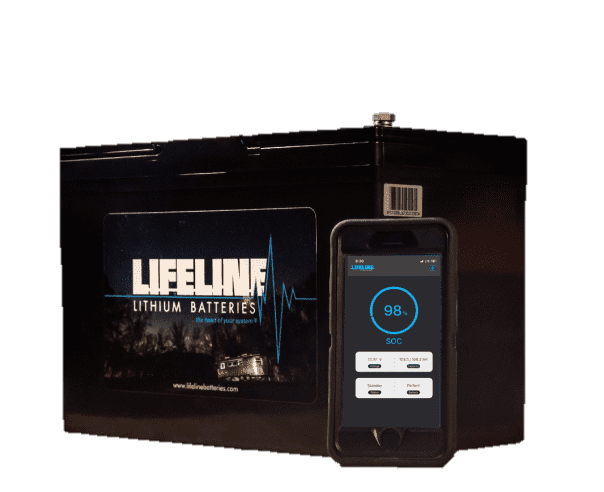

Easily monitor your Lifeline Lithium battery with the Lifeline Batteries Bluetooth App!
- State of Charge Percentage(SCC)
- Invidual Battery Voltage
- Charge and Discharge Current
- Number of Cycles Used
- Battery Temperature
- Remaining Battery Capacity
- Sigle Cell Voltage
- Full Charge Capacity
- Average Time to Empty
- Average Time to Full Charge
- Up to 50 Feet Range



Internal Heating for charging as low as -4°F 
Lifeline Lithium batteries come equipped with an internal heating element that will keep batteries warm even in sub-freezing temperatures!
Are Lifeline Lithium batteries safe? Are they safe?
- Lifeline Lithium batteries are 100% safe & reliable. All Lifeline Lithium batteries are made with Lithium Iron Phosphate (LiFePO4), and do not contain rare earth elements, like Cobalt or other heavy metals. They are non-toxic, including no lead or acid. They are non-corrosive, they do not off gas. They require no watering or maintenance and can be placed in any orientation. In addition, each Lifeline Lithium battery is protected from over-heating, over charging, and short circuiting, by a battery management system (BMS).
- LiFePO4 is a chemical compound made from Lithium (Li), Iron (Fe), and Phosphate (PO4), and is the specific type of lithium battery that we use in all Lifeline Lithium batteries. LiFePO4 batteries are highly regarded for their density and long life compared to other lithium battery chemistries. For example, a Lifeline Lithium battery will have a lifespan of 2000 recharge cycles down to 80% Depth of Discharge (DOD) vs. 400-500 charges for the traditional lithium battery (like the one in your cell phone).
- Lithium Iron Phosphate (LFP) is the most safe and stable lithium battery chemistry. Unlike other lithium batteries, LiFePO4 does not catch fire or explode.
Why Lifeline Lithium? What's makes this Lithium battery better than any other company?
To be honest, there are many other great Lithium Batteries companies in the market today that offer great products. However, Lifeline Lithium batteries offers the largest amount of power in the smallest package available on the market today and includes a Bluetooth feature to help you monitor the state of your batteries from your smart device, as well as a built-in heating element to allow charging as low as -20°F. That’s pretty cool…lol.
What is a BMS and how does it function?
- Each Lifeline Lithium battery is protected from over-heating, over charging, and short circuiting, by a battery management system (BMS). It is a specially designed circuit board with MOSFETS. MOSFETS are a metal-oxide-semiconductor field-effect transistor (MOSFET). They are an electronic device that falls under the category of field-effect transistors (FETs). These devices act as voltage-controlled current sources and are mainly used as switches or for the amplification of electrical signals.
-
When the battery senses a condition that is harmful to the battery, the MOSFETS will protect the LiFePO4 from damage. These conditions include high voltage, over-discharging, over-heating, freezing temperatures and short-circuits.
Do I need a special charger?
Yes and No. Lifeline Lithium batteries will charge with a standard lead acid charger, however there are few things to consider when using a standard lead acid charger:
- The boost voltage of a standard charger is normally around 14.2 – 14.7 volts. When the battery has reached this voltage, the charger will drop off into absorption charge. On many chargers the absorption voltage is too low to finish charging a lithium battery, so the result is that your Lifeline Lithium battery may never be 100% charged. This isn’t a terribly bad thing, but for what these things cost, wouldn’t you rather have a fully charged battery?
-
If your Lifeline Lithium battery shuts down due to being over-discharged, the voltage reading at the terminals will be 0 volts. Many lead acid chargers, or RV inverter/chargers need to see a minimum voltage to begin the charging process. Since the battery is showing 0 volts due to BMS safety protocols, your charger may not start the charging process. Lithium specific chargers will charge Lifeline Lithium batteries when the BMS has shut down to avoid any damages.
How does Lifeline Lithium charge?
Lifeline Lithium batteries are very similar to regular lead-acid batteries, in that they need a charger with an initial boost voltage of at least 14.2 Volts. However, unlike lead-acid batteries, Lifeline Lithium batteries do not need an absorption or float charge. The BMS regulates the incoming bulk charge of 14.2 volts or higher, and when the battery is fully charged, the BMS signals to the charger that it is finished charging and no longer needs any more current.
Can they be charged by multiple charging sources? i.e. Solar and AC power?
Absolutely! Lifeline Lithium batteries can be charged from multiple charging sources simultaneously.
What about low temperature charging? Can Lifeline Lithium be charged in freezing temperatures?
All Lifeline Lithium batteries contain a heating element that warms the Lithium batteries internally before accepting a charge from the charging source.
Can I install Lifeline Lithium in Series or Parallel?
Yes and Yes! Lifeline Lithium batteries can be installed up to 4 in series. There is no maximum on how many can be installed in parallel, but just make sure that you have a big enough charger to charge them with the minimum 20% charge rate.
Why are Lifeline Lithium batteries made up of smaller cylindrical cells?
- Lithium-ion batteries are often made up of many small cells connected in series or parallel to form a larger battery pack. This is because small cells offer several advantages over larger cells, including:
-
Flexibility: Using small cells allows battery manufacturers to create battery packs in a variety of shapes and sizes to fit specific applications. For example, small cylindrical cells can be used in laptop batteries, while flat pouch cells can be used in smartphones.
-
Safety: Small cells are less likely to overheat and catch fire than larger cells. This is because they have a larger surface area to volume ratio, which allows them to dissipate heat more effectively.
-
Reliability: Small cells are less likely to fail than larger cells. If one cell in a large battery fails, it can cause the entire battery to fail. In a battery pack made up of many small cells, if one cell fails, it only affects a small portion of the battery pack.
-
Efficiency: Small cells have a higher energy density than larger cells, which means they can store more energy per unit of volume or weight. This makes them ideal for applications where space and weight are at a premium, such as in portable electronics or electric vehicles.
- Overall, the use of small cells in lithium-ion batteries allows manufacturers to create batteries that are safer, more reliable, more efficient, and more adaptable to a wide range of applications.
How are Lithium Cells manufactured?
-
Lithium is mined from the earth and processed into a form that can be used in batteries.
-
Most of the world's lithium supply comes from salt flats, also known as salars, in South America, where lithium-rich brine is extracted from underground reservoirs. The brine is then pumped into large evaporation ponds, where the water is allowed to evaporate, leaving behind lithium salts.
-
The extracted lithium salts are then further processed to remove impurities and converted into lithium carbonate, a white powder that is the most common form of lithium used in batteries. This powder is then shipped to battery manufacturers, who mix it with other materials, such as graphite, cobalt, and nickel, to create the electrodes that store and release energy in a lithium-ion battery.
-
The electrodes are assembled into cells, and the cells are connected to form a battery pack, which can then be used in a wide variety of applications, from small electronics like smartphones and laptops to larger devices like electric vehicles and power grids.