
Deep-Cycle AGM Batteries
Engineered for superior performance in marine, RV, and off-grid applications. Built to military specifications in the USA.
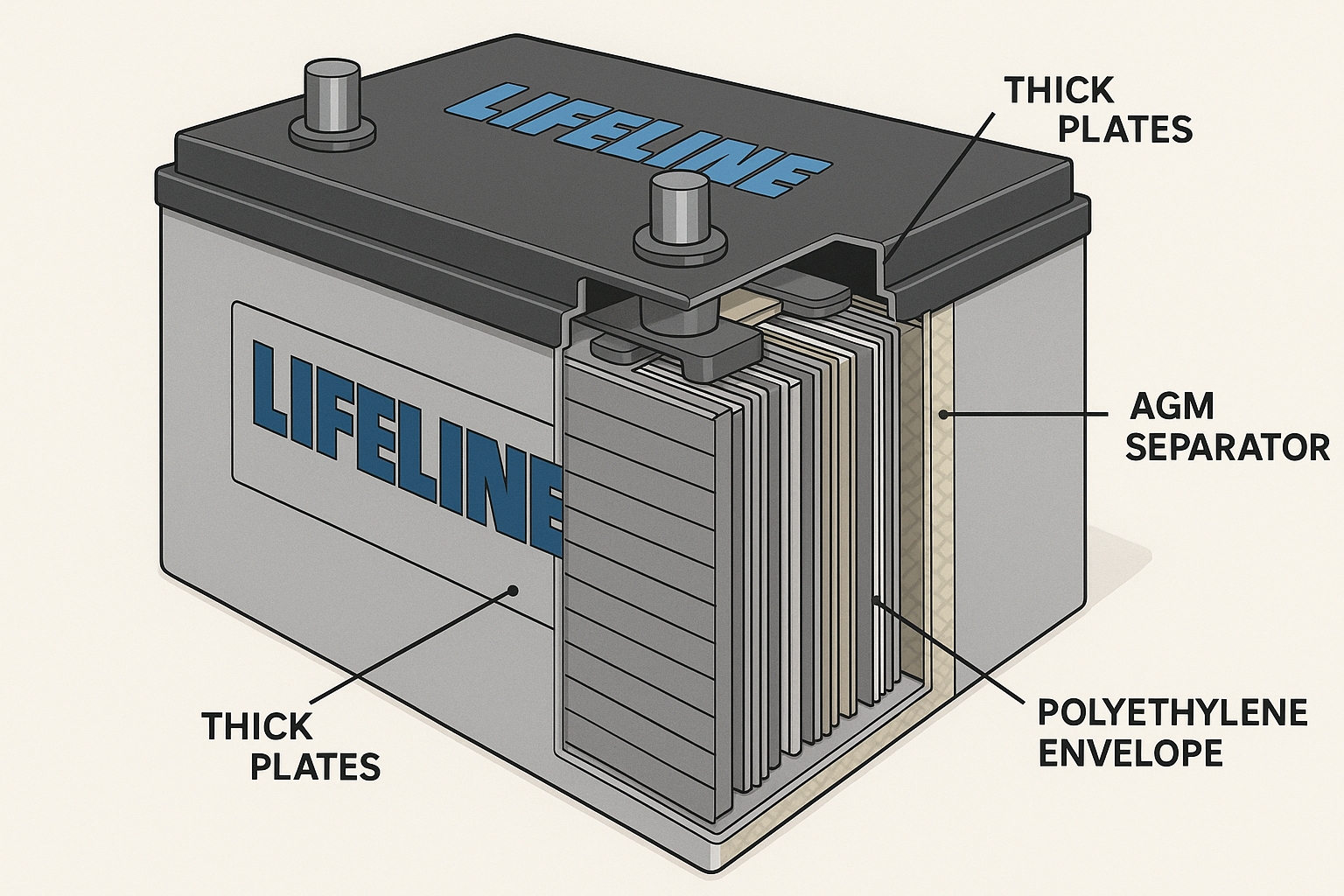
What Makes Lifeline AGM Batteries Superior?
Premium Construction
Performance Benefits
Lifeline Deep-Cycle Product Families
| Voltage Series | Popular Models | Ideal Applications |
|---|---|---|
| 12V GPL Series | GPL-24T, GPL-27T, GPL-31T/XT, GPL-4DL, GPL-8DL | RV house banks, sailboats, small off-grid solar |
| 6V GPL-CT Series | GPL-4CT, GPL-6CT, GPL-L16T | Larger solar arrays, golf-car conversions |
| 2V Cells | GPL-31T-2V, GPL-4CT-2V, GPL-L16T-2V | High-capacity telecom / microgrid strings |
| 16V Racing Series | LL-16/1240TB, LL-1640TB | Drag & circle-track electrical systems |
GPL-24T
12V 80Ah Deep Cycle
Dimensions: 10.22 x 6.6 x 9.25 in
Weight: 56 lbs
CCA: 550A
25A Discharge: 149 min
View DetailsGPL-31T
12V 105Ah Deep Cycle
Dimensions: 12.9 x 6.8 x 9.3 in
Weight: 70 lbs
CCA: 650A
25A Discharge: 195 min
View DetailsGPL-4CT
6V 220Ah Deep Cycle
Dimensions: 10.3 x 7.2 x 10.9 in
Weight: 68 lbs
Terminal: M8 Copper Alloy
Ideal for: Golf carts, solar arrays
View DetailsCore Applications
Marine & Sailing
House banks & auxiliary power systems for sailboats, cruisers, and yachts.
- Withstands constant motion and vibration
- Non-spillable design for any mounting orientation
- Low self-discharge perfect for seasonal use
RV & Motorhome
Electrical systems for travel trailers, fifth wheels, and motorhomes.
- Powers inverters for off-grid capability
- Runs entertainment systems & appliances
- Minimizes maintenance between trips
Off-Grid Power
Solar, wind, and alternative energy storage systems.
- High cycle count at deep discharges
- Excellent charge acceptance
- Reliable performance in extreme temperatures
Electric Vehicles
Golf carts, mobility devices, and industrial EVs.
- Fast recharge capability
- Extended range per charge
- Consistent voltage under load
Industrial
Floor sweepers, forklifts, and material handling equipment.
- High current discharge capability
- Tolerates opportunity charging
- Sealed design for safety in confined spaces
Emergency Backup
UPS systems, traffic signals, and critical infrastructure.
- Reliable cold-weather performance
- Long shelf life with minimal self-discharge
- Fast recovery after deep discharge
Deep-Cycle vs. Starting Batteries
| Attribute | Lifeline Deep-Cycle AGM | Typical Starting Battery |
|---|---|---|
| Plate design | Thick, sponge-free positive plates | Thin, high-surface-area plates |
| Discharge depth tolerated | Up to 80% DOD repeatedly | < 25% DOD (short bursts) |
| Reserve Capacity (RC) | High | Low |
| Cold-cranking amps | Lower | Higher |
| Ideal use | Long, steady draws | Engine cranking |
| Plate thickness | 0.095" to 0.105" | 0.040" to 0.060" |
When to Choose Deep-Cycle
Select a deep-cycle battery when you need power over extended periods rather than intense bursts. While capable of starting engines in many applications, their true strength is providing consistent power over longer timeframes.
Lifespan & Performance Factors
Cycle Life vs. Depth of Discharge

To maximize cycle life, design your battery bank to maintain average depth of discharge below 50%. This can double or triple the lifespan compared to regularly cycling to 80% DOD.
Temperature Effects
Shelf Life
Charging Best Practices
Three-Stage Charging Profile
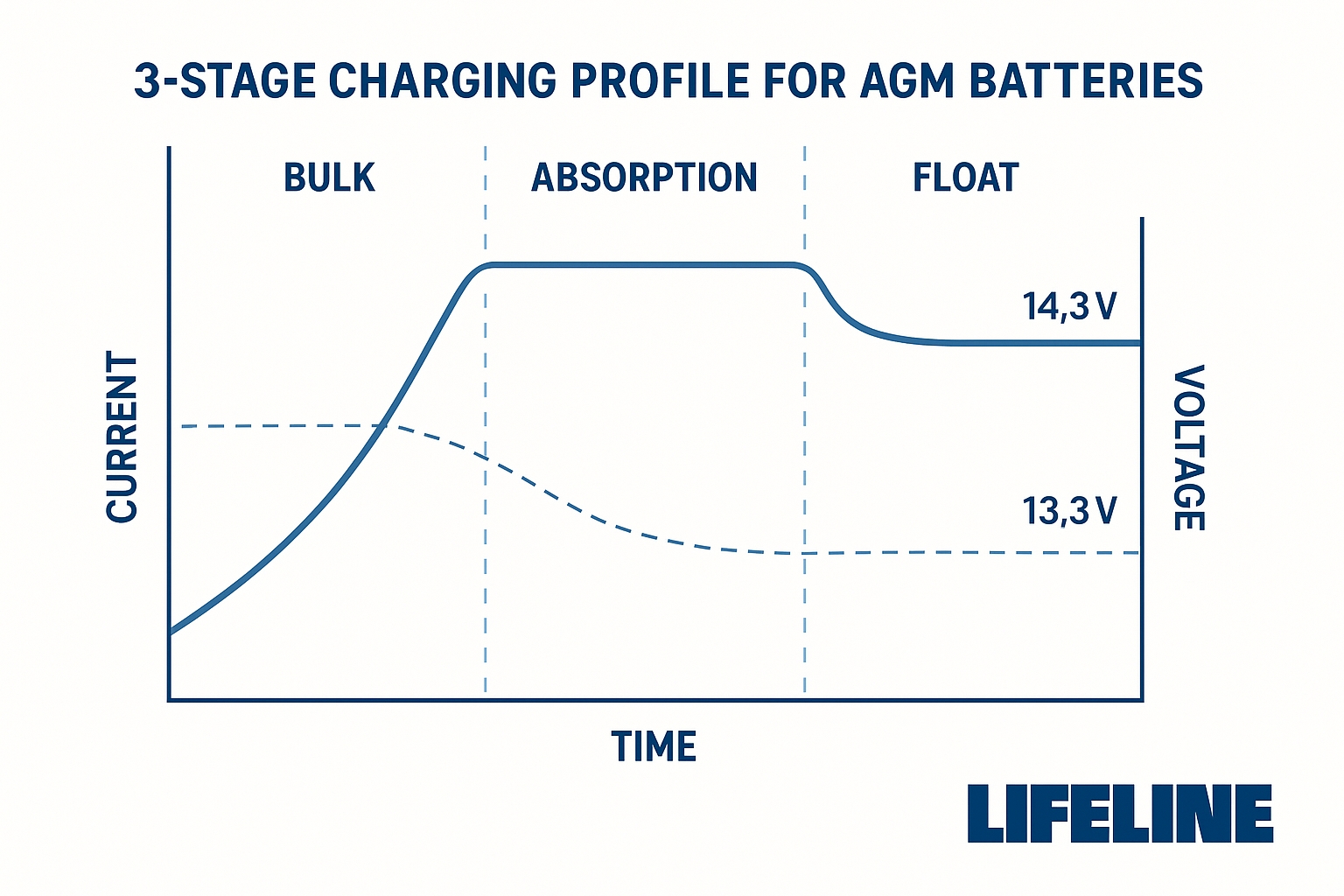
| Stage | Voltage @ 77°F (12V ref.) | Cut-off Condition | Notes |
|---|---|---|---|
| Bulk (CC) | Up to 14.3V | Reaches set voltage | Charger current as high as practical (≥0.2C recommended) |
| Absorption (CV) | 14.3V ± 0.1V | Current ≤ 0.5% C | 2h (<30% DOD) · 3h (30-50%) · 4h (>50%) |
| Float | 13.3V ± 0.1V | Continuous | Temp-comp coefficient 0.0022V/°F · cell |
Temperature Compensation
For optimal battery health, charging voltage must be adjusted based on battery temperature:
| Temperature | Absorption Voltage (12V) | Float Voltage (12V) |
|---|---|---|
| 32°F (0°C) | 15.78V | 14.76V |
| 50°F (10°C) | 15.54V | 14.52V |
| 77°F (25°C) | 14.30V | 13.30V |
| 95°F (35°C) | 14.04V | 13.02V |
| 113°F (45°C) | 13.87V | 13.00V |
Conditioning Charging
A periodic 15.5V (at 77°F) "conditioning" charge for up to 8 hours can recover capacity lost to partial-charge cycling. For routine maintenance, apply a 15.5V conditioning charge for 4 hours every 3-4 weeks.
Routine Maintenance (AGM-Easy)
Quarterly Checks
Remove corrosion with a wire brush. Apply dielectric grease to prevent future corrosion.
Ensure all connections are tight to M6: 35 in-lbs (4.0 Nm) or M8/M10: 70 in-lbs (7.9 Nm).
Record resting voltage and ambient temperature for trend analysis.
Annual Procedures
Perform a controlled discharge test to verify capacity. If below 80% of rated capacity, conditioning may be needed.
Apply a 15.5V (at 77°F) conditioning charge if capacity has reduced or if battery has been cycled repeatedly without full recharge.
Check for physical damage, bulging, or signs of overheating.
The AGM Advantage: No Water Addition
Unlike flooded batteries, Lifeline AGM batteries are sealed and maintenance-free. Never attempt to open the valve or add water — the internal oxygen recombination system manages electrolyte levels for the life of the battery.
Storage Guidelines
- Fully charge the battery
- Clean terminals and connections
- Disconnect negative terminal to prevent parasitic loads
- Store in cool, dry location (60-80°F ideal)
- Check voltage every 5-6 months
- Recharge when voltage drops to 12.5V for 12V batteries (6.25V for 6V)
- Fully charge before installation
- Inspect terminals and clean if necessary
- Check voltage to ensure full charge before use
Important Storage Warning
Never store batteries in a discharged state. Sulfation will occur and can permanently damage the battery. Always charge fully before storage and monitor according to the schedule above.
Safety Essentials
Ventilation Requirements
Even VRLA/AGM batteries can emit small amounts of hydrogen gas when charging. Never seal them inside an airtight enclosure. Ensure installation locations have adequate ventilation.
Thermal Runaway Prevention
To prevent thermal runaway conditions:
- Always use temperature-compensated charging
- Keep batteries away from heat sources
- Ensure proper ventilation around battery banks
- Maintain charging voltages within specified limits
Terminal Protection
AGM batteries have extremely low internal resistance, which means very high short-circuit current capability. Always use insulated tools when working near terminals and never place metal objects across battery terminals.
Personal Safety
When working with batteries:
- Remove jewelry and metal objects
- Use insulated tools
- Wear eye protection
- Have fresh water available to flush skin or eyes in case of acid contact
Troubleshooting Guide
| Symptom | Likely Cause | Recommended Solution |
|---|---|---|
| Rapid voltage drop under load | Undercharging / sulfation | Perform conditioning charge (15.5V @ 77°F); verify absorption stage current cutoff |
| High float-voltage spread (>0.6V on 12V) | Bank imbalance | Conditioning charge or replace weak unit |
| Battery warm during float | Over-voltage or poor ventilation | Check charger set-points & ambient airflow |
| Capacity <50% of rating | End-of-life or severe sulfation | Replace cell(s) or attempt deep-discharge recovery procedure |
| Battery won't accept charge | Deep discharge or charging equipment fault | Constant current charging at 5% of capacity; check charger output |
Technical Support
Lifeline Battery offers direct technical support from the family-owned business. Unlike other manufacturers, when you contact Lifeline, you speak directly with the owners who can answer any technical questions.
Contact Technical SupportEnd-of-Life & Recycling
100% Recyclable
Lifeline AGM batteries are almost 100% recyclable, with all components (lead, plastic, and electrolyte) able to be recovered and reused in new products.
Recycling Process
Return spent units to authorized lead-acid recycling centers. Never dispose of batteries in regular trash, landfills, or by incineration.
Ready to Experience Lifeline Quality?
Find your nearest Lifeline dealer and discover the superior performance of our deep-cycle AGM batteries.